
Learn names through pictures
Volcano interior name typing
Look at the pictures and type the names of volcano interior.
Explore 12 names, one at a time.
volcano interior typing guide →
About Volcano interior name typing
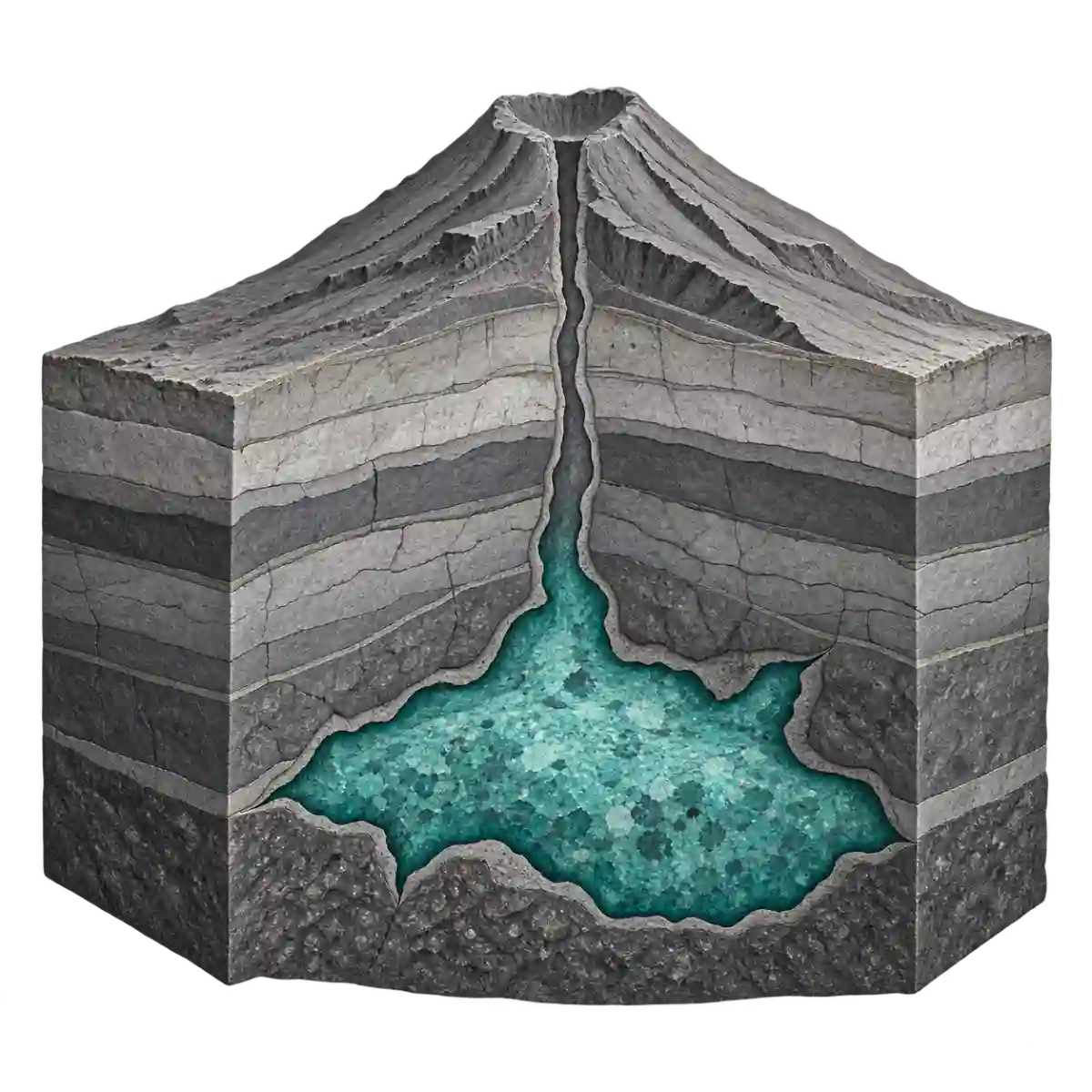
Read storage regions, conduits and intrusions through conceptual volcanic sections. Twelve terms run from Magma reservoir to Country rock rather than naming actual volcanoes. Each target has a visible label to copy, so direct knowledge of underground structures is unnecessary. Compare teal with the surrounding gray rock and notice whether the term names a passage, solidified body or accumulated layer.
Magma reservoir, Main conduit and Lateral conduit precede Central vent and Crater. Dike, Sill and Laccolith introduce intrusions; Volcanic plug, Lava layer, Tephra layer and Country rock complete the set. Summit openings, underground passages and an eroded remnant share a vocabulary list but do not represent one volcano at one moment. The focus is internal position and containment rather than the broader landform list.
A dike cuts across bedding; a sill follows it. The laccolith has a relatively flat base and a domed roof lifting the overlying beds. Crater is not interchangeable with the smaller Central vent, nor an open conduit with a solidified Volcanic plug. A magma reservoir should not be read as an empty cave. Keep an intrusive body separate from the country rock that surrounds it.
These educational models are neither subsurface survey images nor eruption forecasts. The neck represents solidification and erosion; lava and pyroclastic layers show accumulation, while intrusions use simplified bedding comparisons. Colors express selection rather than temperature or natural rock color, and scales vary. A simple reservoir outline does not establish an actual underground boundary; specialist geological review remains pending.
The first nonempty input for Magma reservoir starts the timer. When Main conduit or another new label appears, read its picture and complete name before continuing. A matching answer advances without Enter, and unfinished text can be edited in place. Enter on an incorrect nonempty answer adds one error and clears that attempt. After Country rock, review time, keystrokes per minute and errors; the best time stays in this browser by topic, set and language.
How to play
- Open the basic 12 volcano interior names and read the first label, Magma reservoir, with its selected area.
- Copy a complete label such as Main conduit, or an alternative registered for that particular entry.
- A matched volcano interior name advances automatically; pause to read the new illustration before continuing.
- Edit an unfinished Magma reservoir answer directly. Enter on incorrect nonempty text counts one error and clears the field.
- Finish at Country rock, review the statistics and retry the same 12-name sequence as a new round.
Who is it for?
- Readers beginning volcano interior vocabulary who want a visible name such as Magma reservoir beside a picture.
- Learners comparing the complete spelling and scope of longer labels such as Main conduit.
- Classes or study partners using a fixed sequence of 12 volcano interior names for a short typing activity.
- People who prefer to reach Country rock at their own pace and compare personal time and errors on a retry.
Practice sets
- Basic 12 · 12 names
Copy 12 representative names in order from Magma reservoir to Country rock, comparing the spelling and selected range of terms such as Main conduit.
Names and spelling
A dike cuts across bedding; a sill follows it. The laccolith has a relatively flat base and a domed roof lifting the overlying beds. Crater is not interchangeable with the smaller Central vent, nor an open conduit with a solidified Volcanic plug. A magma reservoir should not be read as an empty cave. Keep an intrusive body separate from the country rock that surrounds it.
The actual display list is Magma reservoir · Main conduit · Lateral conduit · Central vent · Crater · Dike · Sill · Laccolith · Volcanic plug · Lava layer · Tephra layer · Country rock. Each label is an independent entry; a containing structure does not automatically answer for its parts. Use the current-language display name or a specifically registered alternative. The game does not infer arbitrary synonyms, abbreviations or translations. Letter case, spaces and supported punctuation are normalized; Latin accent marks can be omitted and ß can be entered as ss, without changing meaningful word order or numbers.
These educational models are neither subsurface survey images nor eruption forecasts. The neck represents solidification and erosion; lava and pyroclastic layers show accumulation, while intrusions use simplified bedding comparisons.
Practice tips
- A dike cuts across bedding; a sill follows it.
- The laccolith has a relatively flat base and a domed roof lifting the overlying beds.
- Crater is not interchangeable with the smaller Central vent, nor an open conduit with a solidified Volcanic plug.
- A magma reservoir should not be read as an empty cave.
- Copy a complete label such as Main conduit, or an alternative registered for that particular entry.
- Finish at Country rock, review the statistics and retry the same 12-name sequence as a new round.
Frequently asked questions
Which volcano interior names can I practice?
Read storage regions, conduits and intrusions through conceptual volcanic sections. Twelve terms run from Magma reservoir to Country rock rather than naming actual volcanoes.
What does the list from Magma reservoir to Country rock cover?
Magma reservoir, Main conduit and Lateral conduit precede Central vent and Crater. Dike, Sill and Laccolith introduce intrusions; Volcanic plug, Lava layer, Tephra layer and Country rock complete the set.
What distinctions matter when reading Main conduit and related names?
A dike cuts across bedding; a sill follows it. The laccolith has a relatively flat base and a domed roof lifting the overlying beds. Crater is not interchangeable with the smaller Central vent, nor an open conduit with a solidified Volcanic plug.
What are the limits of the volcano interior illustrations?
Colors express selection rather than temperature or natural rock color, and scales vary. A simple reservoir outline does not establish an actual underground boundary; specialist geological review remains pending.
Which written answers work in the volcano interior set?
Use the current-language display name or a specifically registered alternative. The game does not infer arbitrary synonyms, abbreviations or translations. Letter case, spaces and supported punctuation are normalized; Latin accent marks can be omitted and ß can be entered as ss, without changing meaningful word order or numbers.
Where is my result after Country rock stored?
Enter on an incorrect nonempty answer adds one error and clears that attempt. After Country rock, review time, keystrokes per minute and errors; the best time stays in this browser by topic, set and language.
These educational models are neither subsurface survey images nor eruption forecasts. The neck represents solidification and erosion; lava and pyroclastic layers show accumulation, while intrusions use simplified bedding comparisons. Colors express selection rather than temperature or natural rock color, and scales vary. A simple reservoir outline does not establish an actual underground boundary; specialist geological review remains pending.