
Learn names through pictures
Dog breed name typing
Look at the pictures and type the names of dog breeds.
Explore 20 names, one at a time.
About Dog breed name typing
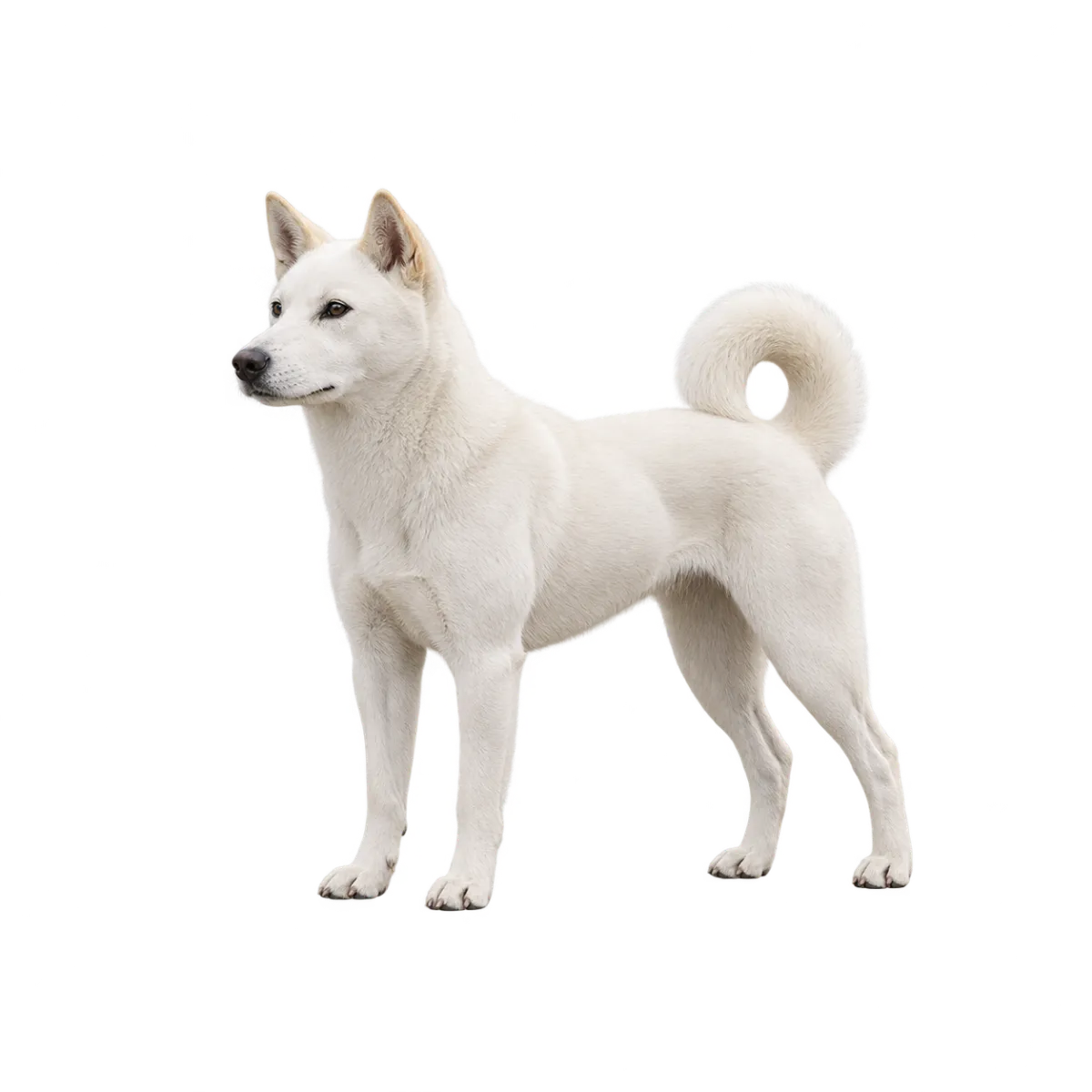
Dog breed names become easier to connect with a picture when you compare the ears, tail, muzzle and body proportions together. This activity displays each complete name beside an adult illustration. Korean Jindo and Shiba share upright ears and a curled tail, yet differ in leg length and body bulk. Copy the visible label at your own pace, using the picture as a reference while you read the spelling.
The basic set follows 20 breeds from Korean Jindo to Dobermann in a fixed order. Corgi means Pembroke Welsh Corgi and Poodle means Standard Poodle here. Natural ears and tails are used throughout; a naturally short French Bulldog tail and a long Corgi tail are both deliberate choices. Each animal is fitted to its card, so the displayed Chihuahua and German Shepherd cannot be measured to compare real heights.
Golden Retriever has a golden long coat and feathering, while Labrador Retriever has a black short coat and a thick otter tail in these examples. Compare the gray facial mask and low brush tail of Siberian Husky with the white neck ruff and plume over the back of Samoyed. Maltese has straight silky hair, whereas Bichon Frise has curls. Coat colors and proportions vary among individuals, so these selected forms cannot establish pedigree or cover every accepted variety.
Displayed dog breeds names include Korean Jindo · Shiba Inu · Pembroke Welsh Corgi · Golden Retriever · Labrador Retriever · Siberian Husky · German Shepherd · Beagle · Standard Poodle · Chihuahua · Pomeranian · Maltese · Shih Tzu · Yorkshire Terrier · Dachshund · French Bulldog · Border Collie · Samoyed · Bichon Frise · Dobermann. Only the current-language label and alternatives registered for that entry are answers; the game does not infer arbitrary translations or synonyms. Japanese hiragana and the displayed Chinese toneless pinyin are also accepted. Case, spaces and supported punctuation are normalized. Latin accents may be omitted and German ß may be typed as ss, while meaningful name differences and numbers remain distinct.
The first nonempty input for Korean Jindo starts the timer. A matching answer advances without Enter, so read longer labels such as Labrador Retriever completely before continuing. You can edit unfinished text directly. Enter on an incorrect nonempty answer adds one error and clears that attempt; empty Enter and Enter during input-method composition do not add errors. After the set’s final label, such as Dobermann, review time, keystrokes per minute and errors, then retry the same sequence. Best times stay in this browser, separated by topic, set and language.
How to play
- Choose a dog breeds set and read the first picture together with its visible label, such as Korean Jindo.
- Copy a complete label such as Labrador Retriever, or use an alternative registered for that entry.
- A matching dog breeds name advances automatically. Read the next illustration and name before typing again.
- Edit unfinished text for Korean Jindo directly; Enter on an incorrect nonempty attempt adds one error and clears the field.
- Reach the final entry, such as Dobermann, review the statistics and retry the same fixed sequence.
Who is it for?
- Beginners who want a visible label such as Korean Jindo beside a dog breeds picture.
- Readers practicing complete spellings and longer labels such as Labrador Retriever at their own pace.
- Classes or study partners dividing 20 dog breeds names into short fixed-order typing sessions.
- People who want to finish at Dobermann and compare their own time and errors on a retry.
Practice sets
- Basic 20 · 20 names
Follow 20 names in dog breeds Basic 20, from Korean Jindo to Dobermann, in the source’s fixed order. Read examples such as Labrador Retriever beside their pictures and practice registered alternatives as well as the full displayed labels.
Names and spelling
Golden Retriever has a golden long coat and feathering, while Labrador Retriever has a black short coat and a thick otter tail in these examples. Compare the gray facial mask and low brush tail of Siberian Husky with the white neck ruff and plume over the back of Samoyed. Maltese has straight silky hair, whereas Bichon Frise has curls. Coat colors and proportions vary among individuals, so these selected forms cannot establish pedigree or cover every accepted variety.
Displayed dog breeds names include Korean Jindo · Shiba Inu · Pembroke Welsh Corgi · Golden Retriever · Labrador Retriever · Siberian Husky · German Shepherd · Beagle · Standard Poodle · Chihuahua · Pomeranian · Maltese · Shih Tzu · Yorkshire Terrier · Dachshund · French Bulldog · Border Collie · Samoyed · Bichon Frise · Dobermann. Only the current-language label and alternatives registered for that entry are answers; the game does not infer arbitrary translations or synonyms. Japanese hiragana and the displayed Chinese toneless pinyin are also accepted. Case, spaces and supported punctuation are normalized. Latin accents may be omitted and German ß may be typed as ss, while meaningful name differences and numbers remain distinct.
Educational illustrations show selected adult coat colors and representative breed proportions; individuals vary widely. The Poodle is Standard and the Corgi is Pembroke. Image sizes do not compare actual heights or establish pedigree.
Practice tips
- Golden Retriever has a golden long coat and feathering, while Labrador Retriever has a black short coat and a thick otter tail in these examples.
- Compare the gray facial mask and low brush tail of Siberian Husky with the white neck ruff and plume over the back of Samoyed.
- Maltese has straight silky hair, whereas Bichon Frise has curls.
- Coat colors and proportions vary among individuals, so these selected forms cannot establish pedigree or cover every accepted variety.
- Copy a complete label such as Labrador Retriever, or use an alternative registered for that entry.
- Reach the final entry, such as Dobermann, review the statistics and retry the same fixed sequence.
Frequently asked questions
Which dog breeds names can I practice?
Dog breed names become easier to connect with a picture when you compare the ears, tail, muzzle and body proportions together. This activity displays each complete name beside an adult illustration. Korean Jindo and Shiba share upright ears and a curled tail, yet differ in leg length and body bulk. Copy the visible label at your own pace, using the picture as a reference while you read the spelling.
What does the range from Korean Jindo to Dobermann cover?
The basic set follows 20 breeds from Korean Jindo to Dobermann in a fixed order. Corgi means Pembroke Welsh Corgi and Poodle means Standard Poodle here. Natural ears and tails are used throughout; a naturally short French Bulldog tail and a long Corgi tail are both deliberate choices. Each animal is fitted to its card, so the displayed Chihuahua and German Shepherd cannot be measured to compare real heights.
How can I compare Labrador Retriever with similar names?
Golden Retriever has a golden long coat and feathering, while Labrador Retriever has a black short coat and a thick otter tail in these examples. Compare the gray facial mask and low brush tail of Siberian Husky with the white neck ruff and plume over the back of Samoyed. Maltese has straight silky hair, whereas Bichon Frise has curls. Coat colors and proportions vary among individuals, so these selected forms cannot establish pedigree or cover every accepted variety.
What are the limits of the dog breeds illustrations?
Educational illustrations show selected adult coat colors and representative breed proportions; individuals vary widely. The Poodle is Standard and the Corgi is Pembroke. Image sizes do not compare actual heights or establish pedigree.
Which spellings and readings work for dog breeds?
Displayed dog breeds names include Korean Jindo · Shiba Inu · Pembroke Welsh Corgi · Golden Retriever · Labrador Retriever · Siberian Husky · German Shepherd · Beagle · Standard Poodle · Chihuahua · Pomeranian · Maltese · Shih Tzu · Yorkshire Terrier · Dachshund · French Bulldog · Border Collie · Samoyed · Bichon Frise · Dobermann. Only the current-language label and alternatives registered for that entry are answers; the game does not infer arbitrary translations or synonyms. Japanese hiragana and the displayed Chinese toneless pinyin are also accepted. Case, spaces and supported punctuation are normalized. Latin accents may be omitted and German ß may be typed as ss, while meaningful name differences and numbers remain distinct.
Where is my result after Dobermann stored?
The first nonempty input for Korean Jindo starts the timer. A matching answer advances without Enter, so read longer labels such as Labrador Retriever completely before continuing. You can edit unfinished text directly. Enter on an incorrect nonempty answer adds one error and clears that attempt; empty Enter and Enter during input-method composition do not add errors. After the set’s final label, such as Dobermann, review time, keystrokes per minute and errors, then retry the same sequence. Best times stay in this browser, separated by topic, set and language.
Educational illustrations show selected adult coat colors and representative breed proportions; individuals vary widely. The Poodle is Standard and the Corgi is Pembroke. Image sizes do not compare actual heights or establish pedigree.